
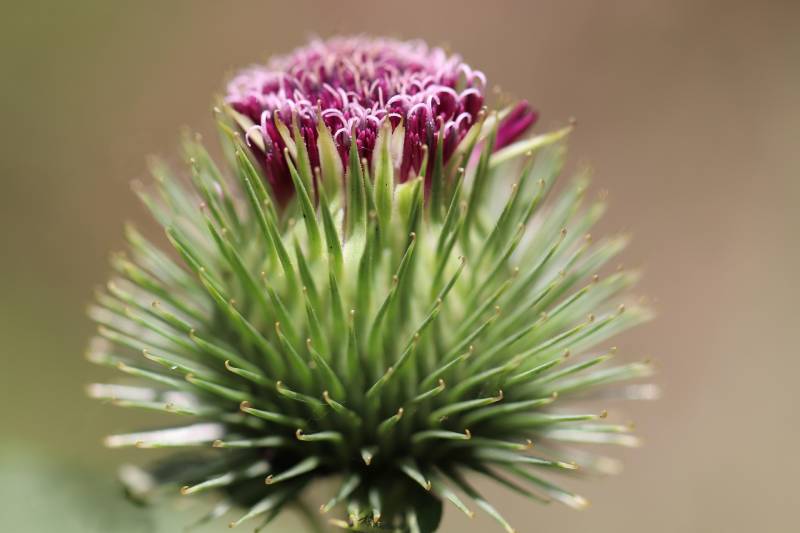
For generations, burdock (Arctium lappa L.) has been known primarily as a “purifying” plant, traditionally used to promote skin well-being and support the body’s physiological elimination processes.
Today, scientific research is allowing us to observe this plant from a completely new perspective.
The focus of interest is no longer just the generic concept of “purification,” but a much more complex network involving the gut, microbiota, metabolism, inflammation, and skin.
And it is precisely this interconnectedness that makes burdock particularly interesting within an integrated approach to health.
A root much more complex than it seems
The most used part of burdock in Western phytotherapy is the root.
Inside it, we find numerous bioactive substances, including:
- inulin and other fructans;
- polysaccharides;
- chlorogenic acid;
- caffeic acid derivatives;
- polyphenolic compounds;
- pectins;
- flavonoids.
Therefore, it is not a single active ingredient that explains the interest in this plant.
Rather, it is the combination of its components that suggests a possible role within that complex relationship connecting diet, intestinal flora, and the body’s response.
The starting point might be the gut
One of the most interesting aspects of burdock is its inulin content, a soluble fiber belonging to the fructan family.
Inulin is not normally digested in the small intestine.
It continues its journey to the colon, where it can become a substrate used by certain microorganisms that make up the gut microbiota.
For this reason, it is considered a fiber with prebiotic activity.
In other words, instead of directly introducing new bacteria as happens with some probiotics, prebiotics help create a favorable nutritional environment for specific populations already present in the gut.
Burdock, however, seems to be more than just a simple natural source of inulin.
Burdock and microbiota: why the whole root is interesting
Some experimental studies have compared the effect of burdock root with that of isolated inulin.
The results suggest that the whole root can influence the microbiota through the combined action of fructans, polyphenols, pectins, and other plant compounds.
This is an important concept.
In nature, in fact, a plant is not made up of a single active ingredient.
Its molecules coexist within a complex matrix and can interact with each other and with our intestinal ecosystem.
Recent research has observed modifications in microbial diversity and bacterial populations associated with the production of short-chain fatty acids, known as SCFAs.
Among these are acetate, propionate, and butyrate: metabolites produced by the fermentation of fibers and increasingly studied for their role in the intestinal environment.
Microbiota and SCFAs: small metabolites, big connections
SCFAs represent one of the most interesting examples of how diet and microbiota can communicate with our body.
These substances participate in maintaining the intestinal environment and are involved in various biological processes linked to the intestinal barrier, metabolism, and the regulation of the immune response.
Research on burdock is therefore shifting the focus:
from the plant that “eliminates toxins” to the plant that can help nourish the intestinal ecosystem.
It is an important change in perspective.
Because if the gut influences numerous body systems, supporting its balance can have consequences that go beyond simple digestion.
From gut to metabolism
The microbiota also participates in the transformation of nutrients and the production of metabolites capable of interacting with our metabolism.
For this reason, in recent years, burdock has also been studied in relation to:
- lipid metabolism;
- glucose metabolism;
- insulin sensitivity;
- oxidative stress;
- inflammatory processes.
Polysaccharides and polyphenols from the root have shown interesting results, especially in experimental studies.
In animal models fed high-fat diets, certain burdock extracts modified the gut microbiota, increased microorganisms associated with SCFA production, and improved some metabolic parameters.
These data do not mean that burdock is a treatment for diabetes, obesity, or lipid disorders.
However, they indicate a very interesting research direction: the gut and metabolism are not two separate systems.
Burdock and inflammation: the second major field of research
Another area that is attracting a lot of attention concerns the anti-inflammatory and antioxidant activity of burdock’s components.
Polyphenols, polysaccharides, and certain lignans present in different parts of the plant are studied for their ability to interact with biological pathways involved in the inflammatory response.
This could help to scientifically understand why burdock has been traditionally used in very different conditions.
Once again, the interesting point is not to imagine the plant as a drug capable of “turning off inflammation.”
It is to understand how some of its components can fit into the body’s physiological regulation mechanisms.
From gut to skin: an increasingly studied connection
And here we come to the property for which burdock is probably best known in Western tradition: skin well-being.
For a long time, there was generic talk of a plant capable of “purifying the blood” and, consequently, improving the skin.
Today, we can interpret this tradition through a different perspective.
The gut, immune system, metabolism, and skin communicate with each other.
This is the principle behind the growing scientific interest in the so-called gut-skin axis.
Alterations in the intestinal environment can be accompanied by changes in the body’s immune and inflammatory response, while diet, stress, and metabolism can simultaneously influence both the gut and the skin.
This does not mean that every dermatological problem originates in the gut.
It does mean, however, that the skin should not necessarily be observed as an isolated organ.
A tradition that research is trying to explain
It is interesting to note that the use of burdock root for certain skin conditions is not a recent development.
Burdock has a long phytotherapeutic tradition, and its use for skin well-being is also recognized in the European herbal tradition.
Contemporary research is studying Arctium lappa and some of its components in relation to various immune and inflammatory mechanisms involved in skin physiology.
Clinical evidence is still limited and does not allow burdock to be considered a therapy for dermatological diseases.
But what emerges is particularly interesting:
a tradition built centuries before the discovery of the microbiota could today find new keys of interpretation in the relationship between gut, immunity, inflammation, and skin.
No longer “detox”, but balance
Speaking of burdock simply as a “detox” plant therefore risks being reductive.
Our body already possesses extremely sophisticated systems for metabolizing and eliminating waste substances, through the liver, kidneys, intestines, lungs, and skin.
Burdock should not be imagined as something that “washes” or “purifies” the blood.
The modern perspective is much more interesting.
We can consider it as a plant containing prebiotic fibers and numerous bioactive compounds that can interact with some of the systems involved in maintaining the body’s balance.
An integrated vision of burdock
Research on burdock also helps to clearly understand a more general principle of integrated health.
A disorder does not always belong to a single organ.
The skin can dialogue with the gut.
The gut can influence metabolism.
The microbiota interacts with the immune system.
Metabolism and the immune response can in turn influence inflammatory processes.
Burdock is located exactly at the center of this network:
GUT → MICROBIOTA → METABOLISM → INFLAMMATION → SKIN
Not because it can control all these systems on its own, but because its composition makes studying its interaction with them particularly interesting.
Conclusion
Burdock is an excellent example of how a plant used for centuries can be reinterpreted through the tools of contemporary science.
Tradition called it “purifying.”
Today, research allows us to use a more precise and, perhaps, even more fascinating language.
The root of Arctium lappa contains inulin, fructans, polysaccharides, and polyphenols capable of interacting with the intestinal environment and are the subject of growing interest for their relationships with the microbiota, metabolism, and inflammatory processes.
Not a miracle remedy and not a simple “detox herb.”
But a complex plant that reminds us of a fundamental principle: health does not arise from isolated organs, but from the balance and continuous communication between different systems of our body.